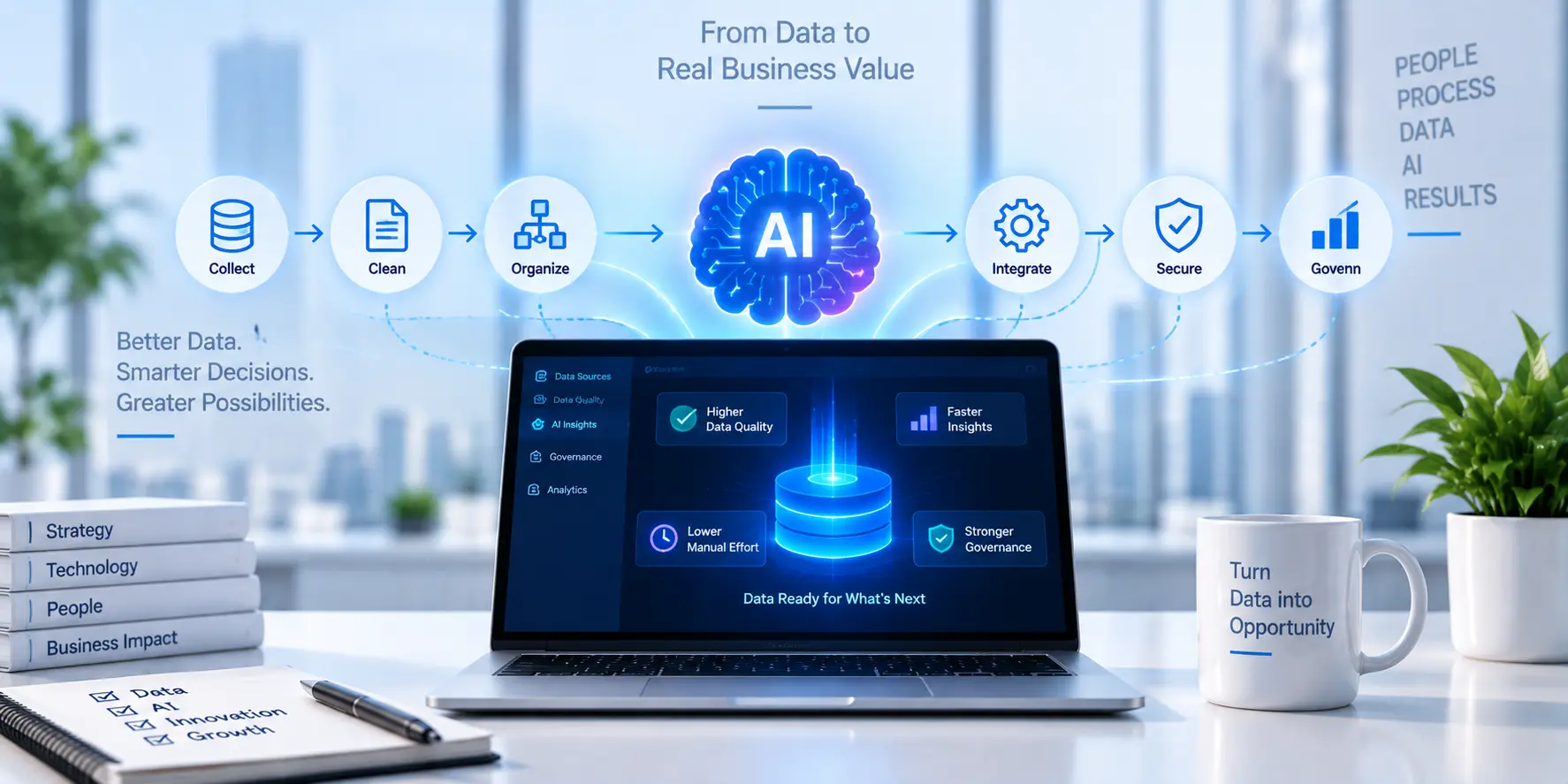
Multimodal AI in Enterprise Workflows- AI has become the forefront of enterprise workflows. The majority of the companies are now relying on AI to automate work and achieve organisational goals efficiently. According to recent surveys, organisations or enterprises have reported regular AI usage in at least one function, with 65–71% adoption rates as of 2024–2025. This highlights the growing importance and surging demand for AI among different organisations for its “multimodal capabilities.” Organisations can downsize their existing workload and manifest better outcomes.
In the sea of AI, ChatGPT emerges as one of the most useful AI tools, streamlining major tasks, thus facilitating efficiency. ChatGPT is a multimodal AI capable of processing, integrating, and reasoning across multiple types of data, known as modalities. Common modalities include text, images, audio, and video. All these four capabilities facilitate an extensive and nuanced understanding of real-world scenarios. Thus, it provides a more versatile and sophisticated user interaction.
In this blog, you will discover how multimodal AI enterprise workflows are becoming a “standard tool” in business operations.
The Rise of Multimodal AI: Deciphered
OpenAI launched ChatGPT on November 30, 2022, which dramatically accelerated interest in AI at work—but enterprise AI adoption was already well underway (≈50% of organizations were using AI in 2022).
Enterprises now want faster results and are always looking for ways to streamline their tasks within a short time. ChatGPT has proven to be a useful tool for streamlining workflow. Also, the various agentic models have further increased the demand for ChatGPT.
Quick Comparison Between Traditional AI Model & Multimodal AI Model
| Traditional or Singular AI Model | Multimodal AI Model |
|---|---|
| Works with only one type of data (e.g., just text, just images, or just audio). | Can process and combine multiple types of data (e.g., text + images + audio + video). |
| Limited to tasks within its input domain (e.g., a text-only chatbot can’t analyze an image). | Can handle cross-domain tasks (e.g., describing an image, analyzing charts, answering questions about a video). |
| Narrow application, usually specialized in one area. | More versatile, as it integrates multiple senses like a human (seeing, reading, listening). |
| GPT-3 (text only), ResNet (image recognition), Whisper (audio transcription). | GPT-4 (text + image), GPT-4o (text + image + real-time audio + vision), Gemini, DALL·E (text-to-image), CLIP (image + text understanding). |
| Writing essays, detecting objects in photos, or transcribing audio—each requires a separate model. | Creating interactive experiences like answering a question about a chart, generating captions for videos, or combining speech + vision for robotics. |
List of 5 Best Multimodal AI Platforms Catered to AI Workflows
Here is the list of 5 best multimodal AI platforms catered to AI workflows:
- OpenAI’s ChatGPT Enterprise
- Microsoft Copilot
- Google Cloud Vertex AI
- DataRobot
- C3 AI
Why Do Enterprises Today Need Multimodal AI?
Using AI is no longer optional. Organisations using AI are expected to achieve significant improvements in workflow efficiency and output quality. Rigorous studies show that using generative AI can lead to 25–40% time savings, and 18–40% quality improvements depending on the task and setting. Public sector pilot programs (like UK Copilot trials) also indicate ~26 minutes/day saved per user.
Enterprises need enterprise multimodal AI tools for text, image, video, and audio to handle and solve different kinds of tasks. Employees are also expected to use AI for streamlining the mundane tasks.
Here are the top 3 solid reasons that mandate the use of AI in today’s fast-paced environment:
- Handling diverse data sources (emails, PDFs, images, recordings, video calls).
- Enabling richer insights and automation.
- Bridging human-like perception across communication modes.
Key Applications in Enterprise Workflows
a. Text + Image
- Automated document processing (contracts, invoices with diagrams).
- Compliance checks (scanning text & charts for anomalies).
b. Text + Audio
- Meeting transcription and summarization.
- Voice-driven workflows and multilingual customer support.
c. Text + Video
- Training and onboarding through AI video summarization.
- Security and surveillance analysis with contextual reports.
d. Text + Image + Video + Audio (Full Multimodality)
- Smart assistants that interpret documents, listen to queries, and present visual reports.
- Finance, and manufacturing examples.
Benefits of Multimodal AI for Enterprises
- Enhanced productivity and efficiency
AI tools are great at streamlining tasks involving intense attention or research. It is not a complete “replacement tool,” but rather a tool for speeding up work. - Improved accuracy in decision-making
AI reduces research time, helps decision-making, and allows more work in less time. - Better employee and customer experiences
With multimodal AI, enterprises can craft better customer strategies and improve employee engagement. - Cost savings through automation
AI reduces overheads and eliminates redundant tasks, enabling smaller teams to achieve more.
Challenges & Considerations
- Data privacy and governance
AI models sometimes hallucinate or face data confidentiality challenges. - Integration with legacy systems
Compatibility issues and additional training may lead to higher costs. - Scalability and infrastructure demands
Enterprises must prepare strategies to meet AI’s scalability requirements. - Ethical use and bias mitigation
AI models can be biased if trained on faulty data. Ethical frameworks are essential.
How to Implement Multimodal AI in Enterprise Workflows?
Implementing multimodal AI enterprise solutions is not just about adopting new tools but about aligning them with business priorities. Here are some detailed strategies:
- Start with business problems, not technology. Focus on pain points like compliance delays, customer support inefficiencies, or onboarding complexity.
- Identify high-value use cases. Prioritize AI in workflows like risk compliance, multilingual customer service, and internal training.
- Leverage cloud-based AI platforms and APIs. Tools like Microsoft Copilot consulting services and TrnDigital’s AI integration platforms make deployment faster.
- Build cross-functional adoption teams. Include IT, business leaders, compliance officers, and HR.
- Develop an AI Center of Excellence. This central hub ensures continuous innovation, governance, and best practices.
- Ensure robust AI data extraction workflows. Handling contracts, invoices, and reports requires automation accuracy.
- Invest in employee upskilling. Employees should be trained on prompts, workflow automation, and ethical use.
- Integrate with existing systems. Smooth migration ensures minimal disruption.
When businesses focus on how to implement multimodal AI in business operations, the transformation becomes smoother, more scalable, and ROI-driven.
Future of Multimodal AI in Enterprises
The future of enterprise multimodal AI tools for text, image, video, and audio is highly promising:
- Evolution toward autonomous decision-making systems. Enterprises will see AI moving from task automation to decision-level autonomy.
- Real-time multimodal analytics. Organisations will use AI to monitor, analyse, and act instantly on cross-channel data.
- Human-AI collaboration as the new digital workplace. Employees won’t compete with AI but partner with it, allowing more focus on creativity and strategy.
- Integration with edge computing. Faster, real-time AI deployments across manufacturing, and security.
- Industry-specific use cases. Banking fraud detection, and smart factories will rely heavily on multimodal AI.
In short, multimodal AI enterprise adoption is not just about keeping pace with technology but about reshaping the way enterprises operate at scale.
Conclusion
Multimodal AI is not just a passing trend but a long-term transformation in the way enterprises function. From handling diverse data to enabling human-like interactions, enterprise multimodal AI tools for text, image, video, and audio are shaping the future of workflows.
Enterprises that adopt early will not only streamline operations but also gain a sustainable competitive edge. Partnering with trusted providers like TrnDigital, which specializes in AI data extraction, AI Center of Excellence, and Microsoft Copilot consulting services, can help organisations design and deploy enterprise-ready solutions.
In today’s fast-paced digital environment, embracing multimodal AI enterprise solutions means securing the future of business operations with efficiency, accuracy, and innovation.