The adoption curve shows agents being rolled out faster than the governance framework can handle them. This problem is called agent governance, where different teams deploy their own agents with varying access, owners, and even no owner at all. What makes matters tricky isn’t just a rogue agent, but a complete failure to have governance around your entire suite of agents. Gartner found that 95% of infrastructure and operations teams experienced at least one agent-related incident last year. Their projection says that, without proper governance, 40% of enterprises deploying AI will face critical downtime caused by rogue agents by 2028.
But here’s the deal: agent governance is a matter of governance. Not just a matter of securing whatever you’ve done.
This guide walks you through defining AI agent governance, implementing it within your existing Microsoft stack, and proving your success along the way. In practice, this framework pulls all the controls described previously into a programmatic structure. You will have a simple way to answer one critical question: Who is controlling our agents?
Defining AI Agent Governance
What does AI agent governance encompass? First off, it covers your program around building, deploying, and running those agents. What information can an agent access? What action can an agent execute? Who owns and operates an agent? Finally, it covers how agents running in production environments are monitored and terminated when necessary.
Just like other types of governance, this topic is less about products and more about processes. All agents need to be governed equally, regardless of how new they are or how much time you’ve spent building them. There is a parallel here in hiring employees. An employee comes on board, receives an identity, gets a role and manager, receives access privileges, and maintains an activity log. Now the same applies to an agent. Your agents must function inside your environment under the same governance model that employees follow. That’s fundamental.
A Practical AI Agent Governance Framework
A workable framework comes down to six parts. Each one answers a single question about an agent, and each maps to a control you can stand up now. Together they form the backbone of any agentic AI governance playbook, and they give you governance you can actually prove rather than just write down.
| Governance pillar | The question it answers | What it covers |
| Identity and lifecycle | Who is this agent, and who owns it? | Each agent gets its own identity, a named owner, and a full lifecycle from create to retire |
| Permissions and integrations | What can it reach? | Least privilege for every agent and tool, and review of the integrations it connects to |
| Input integrity | Can it be tricked? | Defense against hidden instructions in the content an agent reads |
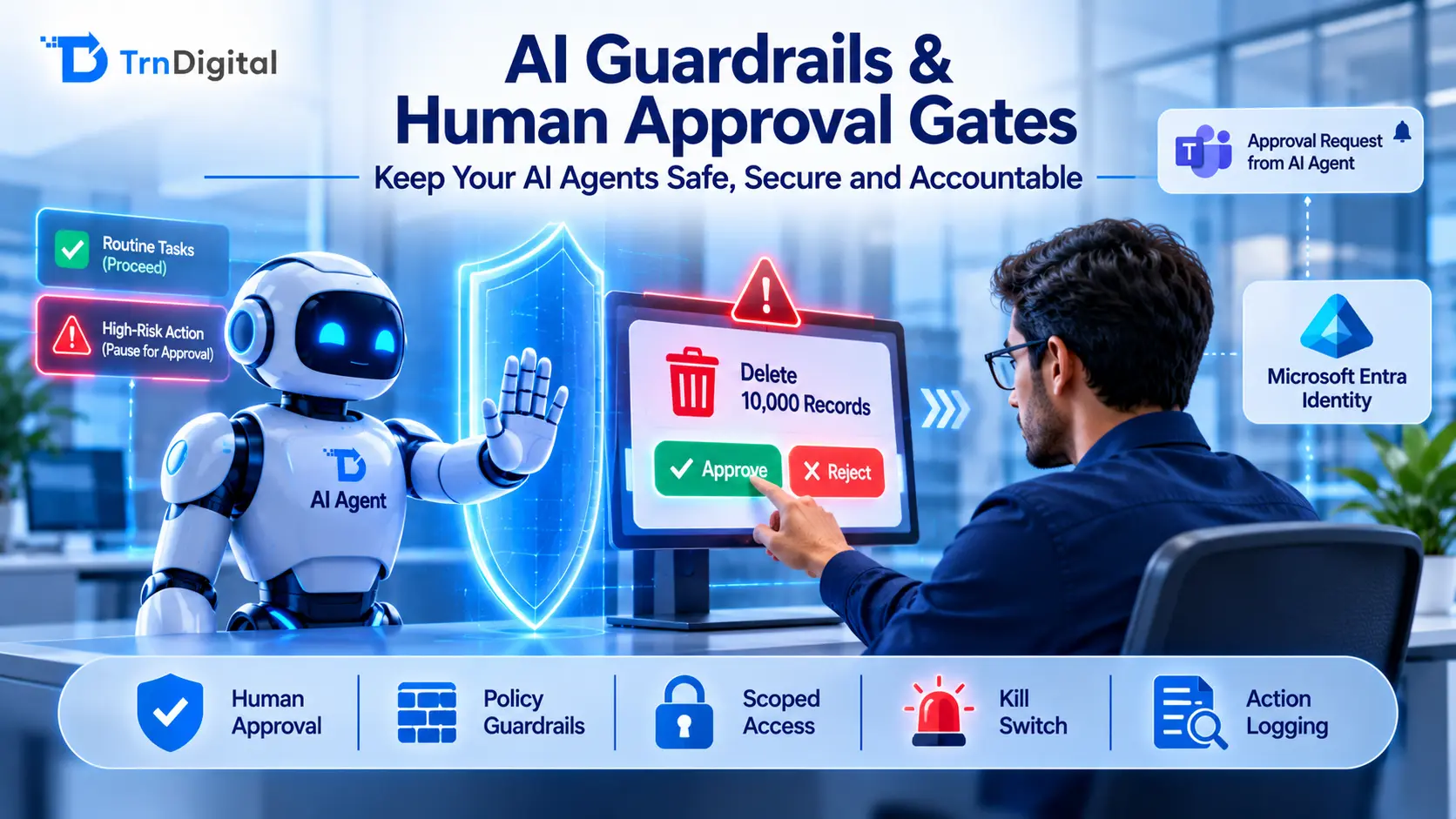
| Human approval and runtime controls | What stops a bad action? | Approval gates for high-impact actions, plus guardrails and a kill switch |
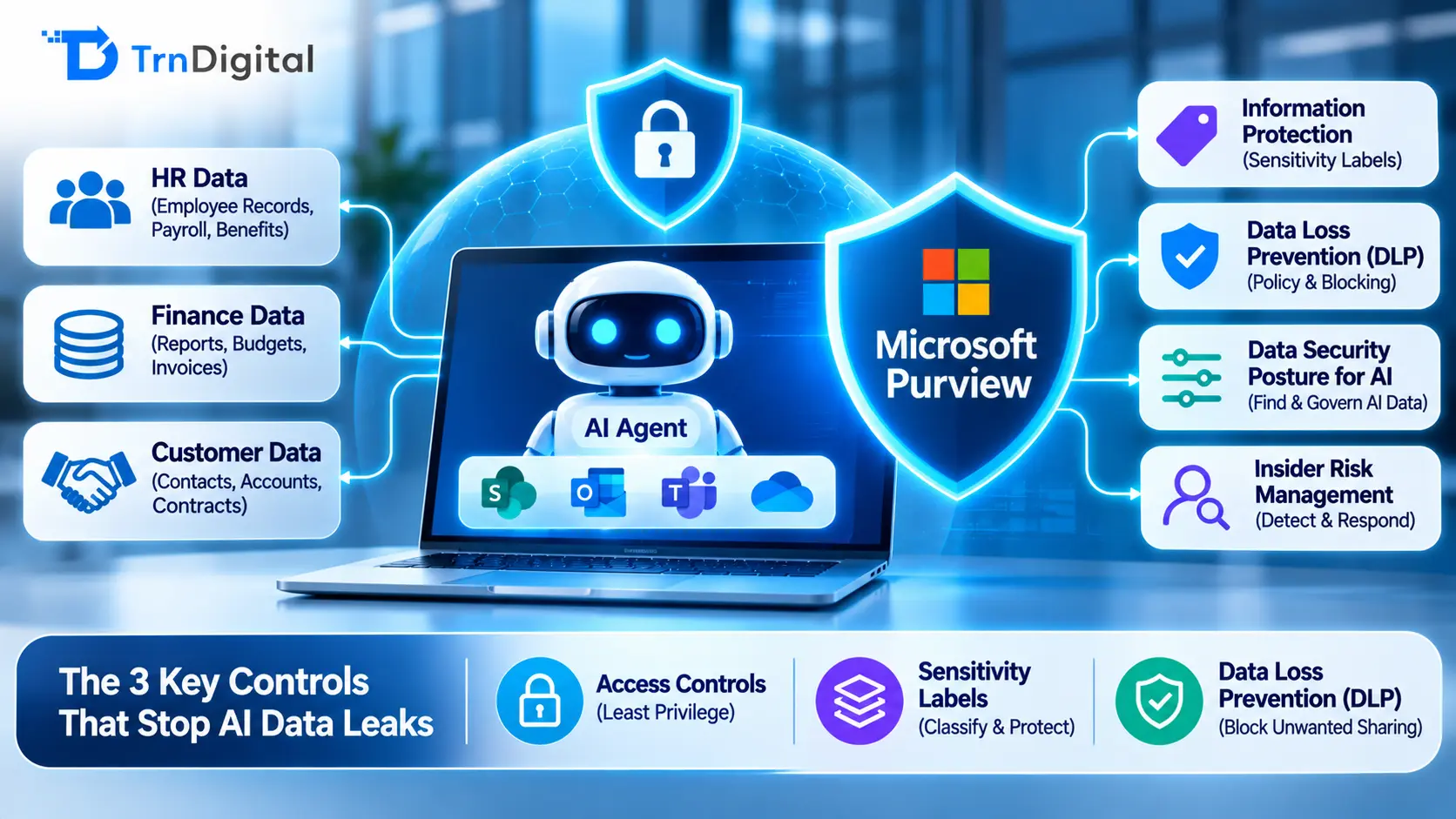
| Data protection | Can it leak sensitive data? | Controls on the data an agent can see, label, and share |
| Observability and audit | Can you prove what it did? | A log of every action, with alerts on the risky ones |
Each pillar is a deep topic in its own right, and we cover them one at a time across this series. Identity comes first. Every agent should carry its own identity, with scoped permissions and a full lifecycle. Because an agent acts on whatever it reads, treat that content as untrusted. An attacker can plant a hidden instruction in an email, document, or website and steer the agent from the outside. Most of the real exposure, though, sits in the access itself, usually as excessive permissions and untrusted integrations. For anything an agent cannot undo, add human approval gates and runtime controls so a bad action is caught before it runs. Sensitive data needs its own guardrails, which is where you prevent sensitive data exposure with Microsoft Purview and DLP. And none of it counts for much unless you log every action an agent takes and can reconstruct it later. Governance is the thread that ties these six together.
Why Point Controls Fail to Protect You
Where do most companies start? With isolated controls. One group builds an identity for its agents. Another puts in place a gate requiring human approval. Another starts logging activities for their agent. These controls, individually, make perfect sense. Taken together, however, they add up to zero. Why? Request a consolidated list of all agents within the organization. No one will deliver such a report. Agents created independently lack owners. Agents used for a short-term experiment retain unnecessary access for months. Agents persist long after completing the project for which they were initially created. You cannot address this issue with a single tool because the issue itself is structural. Your controls cannot span all agents without the existence of an overarching framework. Otherwise, your approach to agentic AI governance leaves little to stand behind except good intentions.
Tiered Controls Based on Agent Risk
It doesn’t govern every single one of your agents identically. An agent performing routine report generation carries lower risks. But an agent authorized to delete records, move funds around, and send emails to customers carries a higher risk level. Applying maximum controls uniformly across all agents causes agents to circumvent your process altogether. On the flip side, applying light controls to all agents risks missing a higher-risk case entirely.
Instead, the best practice approach involves a tiered classification system. Define your tiers based on your agents’ access permissions and capabilities during creation. For a low-risk agent, a minimal review process suffices. But for high-risk agents, enforce strict access requirements, human approvals, and diligent oversight.
How AI Agents Are Governed on the Microsoft Stack
The beauty of AI agent governance is its ability to leverage the tools you already pay for. You can use the built-in capability in Microsoft Entra Agent ID to give each agent its unique identifier and enable centralized governance, scoping, and rapid termination if required.
Beyond that, all remaining governance controls are provided by products with your enterprise license. Conditional Access enables least privilege permissions across all agents. Purview protects against data breaches for any information accessible to an agent and applies agentic AI data governance controls. Finally, auditing tracks each activity performed by agents.
The goal isn’t to layer yet another security control on top of everything else. Rather, your goal is to establish a single cohesive governance framework leveraging the native capabilities of all Microsoft products available to you today.
What to Measure
Governance only works if you can see it. A few measures tell you whether your program is real or just written down. Track these from the start.
| What to measure | Why it matters |
| Agents with a named owner | Every agent should have one, with no exceptions |
| Agents with access reviewed in the last quarter | Access drifts over time if no one checks it |
| High-risk agents with approval gates in place | The actions that can cause harm are the ones to protect |
| Agent-related incidents per quarter | A rising number signals a control that is missing or weak |
| Inactive agents still holding access | Unused agents should be retired, not left open |
Numbers like these move governance from a document into daily practice, and they give leadership a straight read on where the risk actually sits.
TrnDigital AI Agent Governance Assistance
TrnDigital helps enterprises deploy AI agent governance as part of their broader rollout for U.S. enterprises working within the Microsoft ecosystem. Our services begin with discovering all existing agents in the tenant and assigning ownership over them. We developed the six-pillar framework for agent governance, categorized them based on risk, applied appropriate controls using Microsoft Entra, Purview, and existing Microsoft security products. To enforce standardization across every team developing its own agents, we also support setting up an internal AI center of excellence. Curious about how many agents currently run inside your organization or who owns them? Let us conduct an AI readiness assessment first and map out all agents prior to production deployment.
Commonly Asked Questions About AI Agent Governance
1. What Is AI Agent Governance?
Definitionally, AI agent governance refers to your overall program for managing AI agents. It establishes which resources an agent accesses, what functions an agent performs, and which entity takes responsibility for doing so. Moreover, it covers how an agent operates once deployed into production and how to terminate it. Simply put, you want to apply consistent governance controls to every agent across the organization.
2. How Does AI Governance Differ From Agentic AI Governance?
While conventional AI governance focuses on your entire enterprise’s use of AI (models, data, responsible use), agentic AI governance focuses specifically on the agents themselves. The difference? Agents carry extra controls compared to conventional models because they aren’t purely analytical tools generating results. Instead, they carry out actions within your environment. Hence the extra layers of identity, permissions, human approval, and audits needed per-agent.
3. Which Best Practices Should You Implement?
Agentic AI governance consists of straightforward principles. Assign each agent an identity and a distinct owner. Least privilege for access controls. Approval gates for high-risk actions. Data protection for agent data. Monitor and audit each agent activity consistently.
4. What Constitutes Your AI Agent Governance Framework?
A proper governance framework entails six pillars: Identity Lifecycle, Permissions and Integrations, Input Integrity, Runtime Controls and Approvals, Data Protection, and Observability and Auditing. Every pillar poses one key question related to the agent. And together, they compose your governance program for each agent.
5. Whose Responsibility Is AI Governance?
For optimal implementation, AI governance needs one central owner for all governance controls. Typically, this group establishes universal AI governance standards and assigns each agent a clear owner. An internal AI center of excellence manages governance standards while the owner manages each agent individually. Security and IT directors oversee governance implementation enterprise-wide.
Conclusion
AI agents automate work tasks better than anything else today. Your organization has rolled out AI agents faster than anyone expected. But there is no coherent plan for how they operate across systems. Fortunately, the solution involves a unified governance program for all agents assigning identities and permissions; enforcing least privilege access controls; requiring approval gates; protecting data; monitoring and auditing activities; and aligning those controls based on risk profile. All done using the Microsoft technology stack you’ve invested in and already rely on. Monitor a small set of key performance indicators. Proving that your agent governance program succeeds becomes effortless. When someone inevitably asks, Who is controlling our agents? you know precisely whom to point toward. Need help implementing your governance program? Reach out to TrnDigital.